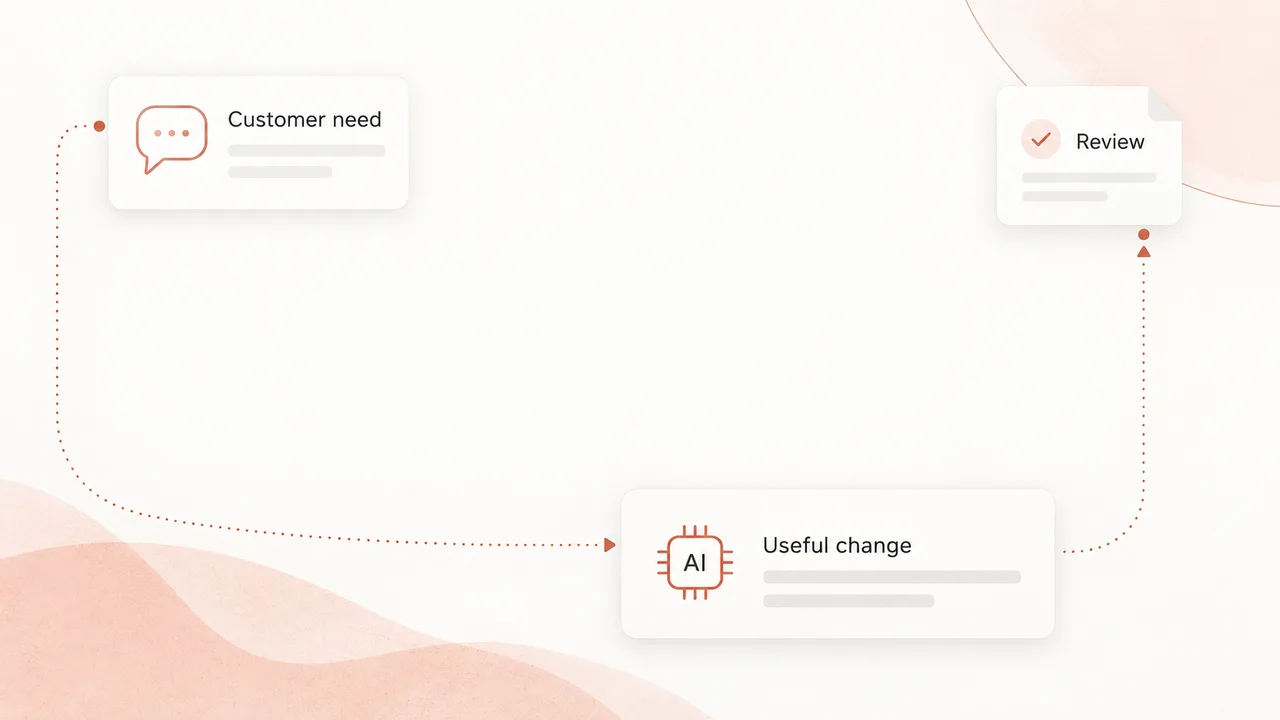
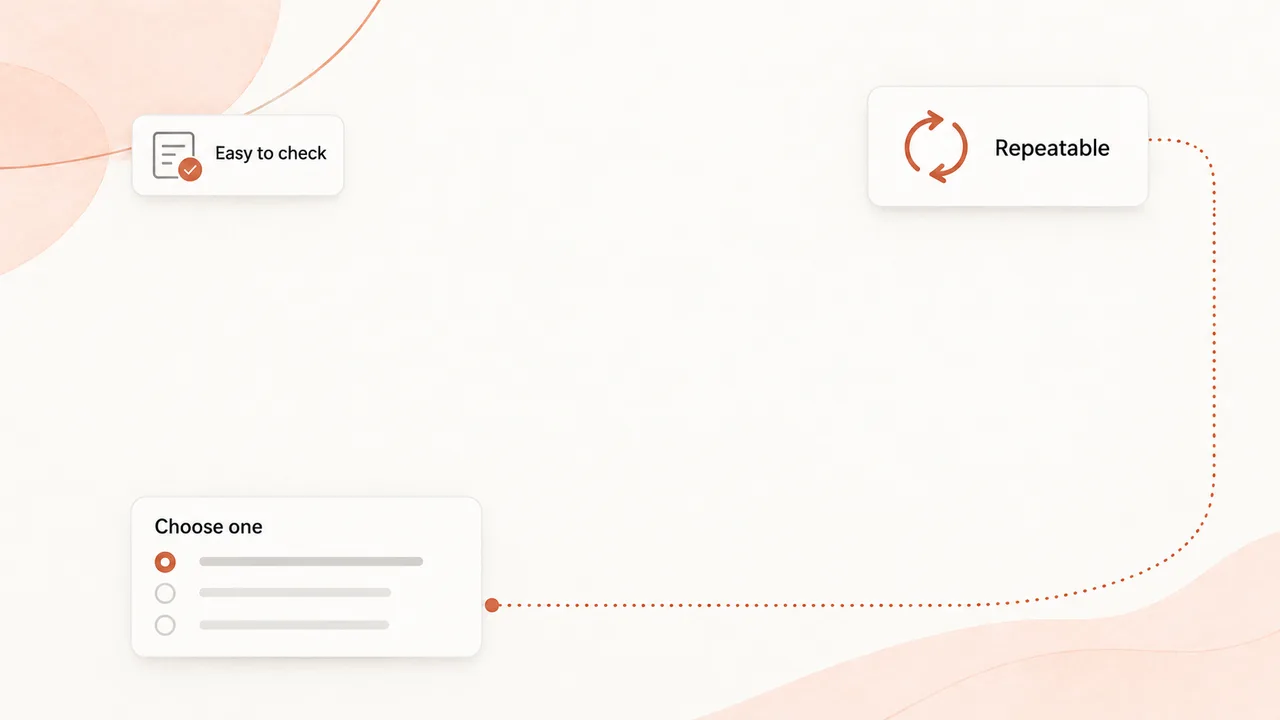
Choose a first automation that handles recurring work, has a clear start and finish, and lets someone check the result before a mistake reaches a customer. A frequent, bounded task with usable information is a stronger starting point than a whole department described as “too busy”.
That still leaves several possibilities. Should you begin with enquiries, document handling, reporting or customer follow-up? Use the selection method below to compare real tasks and decide whether each needs AI, ordinary automation or a simpler working agreement.
If you have not yet decided which business result matters, start with where AI can create value in your business model. This article assumes you have a problem worth addressing and need to choose the first process.
Describe the work at the level you can change
“Automate sales” is too broad to assess. “Create a draft CRM note after an approved meeting summary” is specific enough to discuss with the person doing it.
For each candidate, write down:
- The trigger: what starts the task?
- The input: which message, document or record is needed?
- The action: what does someone do with it?
- The finish: what must exist before the task is complete?
- The exception: when does the normal approach stop working?
Follow a few recent examples from beginning to end. Include an awkward one. A process that looks consistent in a meeting may depend on someone quietly resolving missing information every morning.
Remove unnecessary steps before automating them. The no-frills business model offers a useful perspective on keeping the core benefit and questioning extras. Applied to your own process, that means asking whether a report needs to exist before building a faster way to produce it.
Decide which kind of help the task needs
Use a working agreement when the problem is ownership or an unclear decision. Assigning an enquiry to a named person may solve more than generating a better summary.
Use ordinary automation when the rule is explicit. Copying an approved form response into a matching field, calculating a total or creating a reminder on an agreed date does not necessarily require AI.
Consider AI assistance when the input varies and needs interpretation, such as turning a free-text request into a draft summary. Keep exact calculations and authoritative records in the systems responsible for them.
Anthropic’s guidance on building effective agents recommends starting with the simplest approach that meets the need and adding complexity when justified. Its distinction between predefined workflows and more autonomous agents is useful here; the article is technical guidance, not a recommendation that every business needs an agent.
One process can combine these approaches. An agreed rule assigns the owner, AI prepares a summary, and a person approves the response.
Compare the candidates with six questions
Avoid a complicated score that makes uncertain estimates look precise. For each question, record a concrete answer or an unresolved condition.
| Selection question | A promising first candidate | A reason to investigate further |
|---|---|---|
| Does it recur often enough? | Recent examples show meaningful cumulative effort | The task is occasional or every case is different |
| Are the inputs usable? | Required records are available and maintained | Information is missing, conflicting or inaccessible |
| Is a good result recognisable? | A colleague can describe and check it | Success depends on unstated judgement |
| Can review fit into the work? | Checking takes less effort than doing the whole task | Every output needs to be rebuilt |
| Can errors be contained? | Drafts stay internal until approved | A mistake immediately changes a commitment or payment |
| Does someone own the process? | A named person can test it and handle exceptions | Everyone benefits, but nobody has time to maintain it |
Treat missing ownership and unusable inputs as reasons to postpone the trial. A high volume of work does not cancel those problems. Where errors could materially affect someone’s rights, finances or safety, get the relevant expertise involved before choosing an automated approach.
A worked example: a small project consultancy
Imagine a consultancy considering three tasks. These are illustrative assumptions, not a client case or predicted results.
Recording meeting outcomes is repetitive, and the consultant can compare a draft with approved notes. It has a clear finish: an accurate CRM entry with the agreed next step. It could be a first AI-assisted trial if the information is appropriate to process and review effort stays manageable.
Sending reminders for agreed actions follows a date and an owner. A standard reminder in the existing system may already solve it. There is little reason to introduce generated text if a simple notification is sufficient.
Setting the final project price depends on scope, capacity and commercial judgement. An AI-prepared summary may help, but letting it set and send the price would expand the consequences considerably. Keep that decision with the responsible person.
The first two candidates might both be worthwhile. Choose based on the current bottleneck: missed follow-up points towards reminders; excessive note preparation points towards a draft-summary trial. The point is to match the intervention to the observed problem.
That is also the starting point for our work on customer follow-up and sales: make ownership and next steps visible before adding more activity.
Check the economics without promising savings
Measure the current handling time and how often the task occurs. For the proposed approach, include preparation, checking, corrections, failed attempts and routine maintenance, as well as software charges.
Compare total effort per completed task. If a summary takes less time to generate but much longer to verify, the faster first step is misleading. Also record quality: an omitted customer requirement can matter more than a few saved minutes.
Use a small test to establish whether further work is justified. Include common cases and the exceptions your team expects. A small sample can reveal problems; it cannot establish that every future case will be handled correctly.
Set the boundary before starting
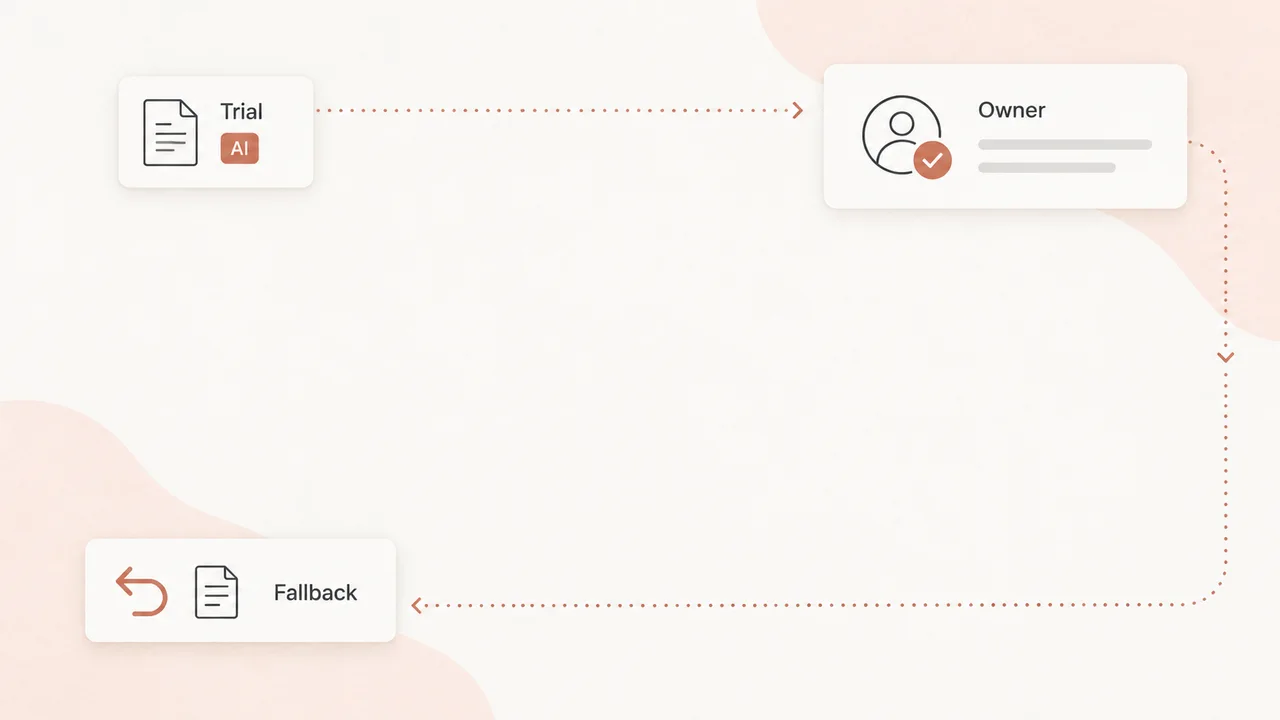
Make the first trial easy to explain: one type of input, one output and one responsible reviewer. State what the system may prepare, what it may change and what it must leave to a person.
Agree how exceptions return to the normal process and what would cause you to pause. Check access and data handling before using real customer information. Once a trial is useful, follow the separate guide to turning an AI experiment into an everyday workflow.
Untaylored helps connect recurring work through practical automation, starting from the way your business operates. If the choice between several processes remains unclear, AI strategy and advice can help make that decision concrete.
Book a demo for an introductory conversation and bring two tasks your team repeats. We can use their inputs, outcomes and exceptions to discuss a sensible starting point.