A new market can look attractive long before you know whether its customers will buy. Complaints suggest an unmet need, a competitor’s offer leaves an apparent gap, and an AI-generated analysis turns those fragments into a convincing growth story. The investment decision still depends on something harder to establish: whether a particular customer has a problem worth paying you to solve.
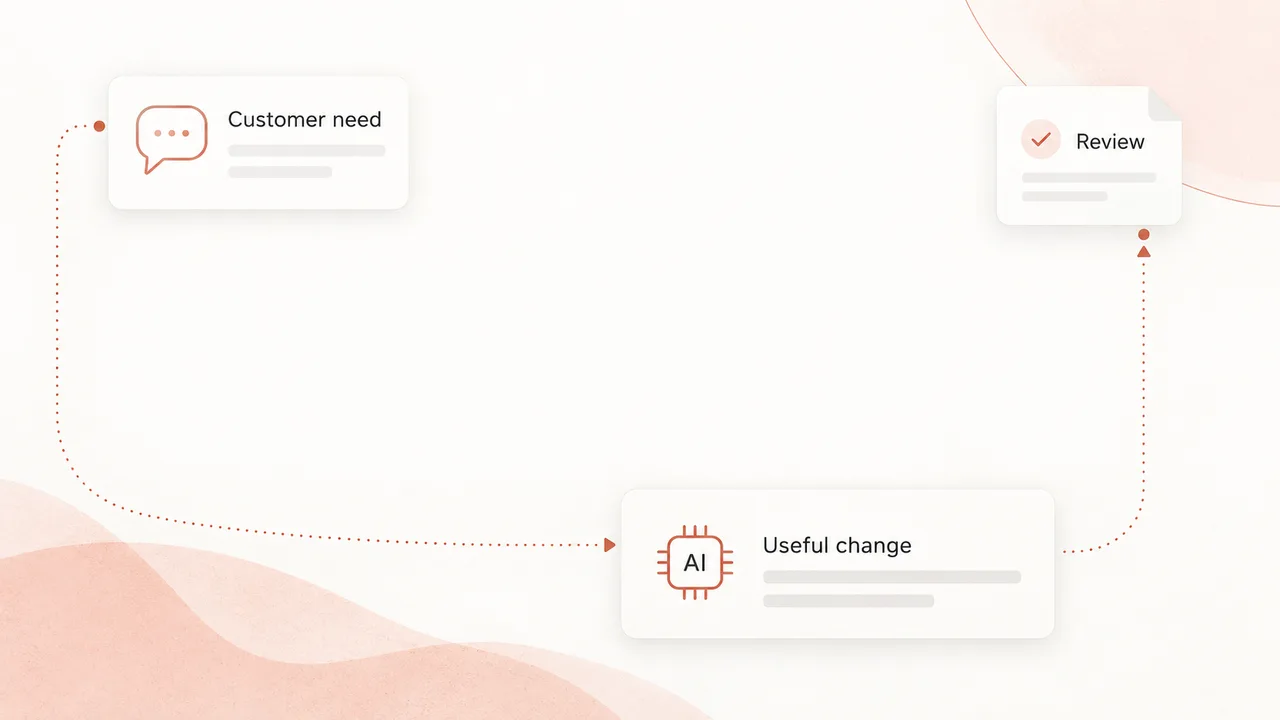
AI-driven opportunity discovery can help you investigate that question. Use AI to organize relevant material, compare explanations and prepare questions for prospective customers. Then use conversations and a practical market test to decide what deserves further investment. The useful result is a traceable decision: what the evidence supports, what remains uncertain and what to test next.
The five steps below follow that path. A fictional maintenance provider, considering scheduled service for small retailers with several locations, illustrates how it works. This is an example of the reasoning, not a client case or a validated market opportunity.
Where AI helps with market research
Reading actual customer material and asking AI to invent customer opinions are different tasks.
Research by Artem Timoshenko, Chengfeng Mao and John R. Hauser examines the first task: identifying customer needs from source material. Across five interrelated studies involving market-research professionals, an industry partner and professionally sourced material, their study of AI-assisted customer-needs research reports stronger need formulation with specially trained models than with base models. That supports exploring AI as a research assistant. It does not establish that an ordinary chat session will produce the same quality, or that an identified need represents demand for your offer.
The second task requires particular caution. In the April 2026 revision of Using LLMs for Market Research, James Brand, Ayelet Israeli and Donald Ngwe compared generated preferences with five studies of US adults choosing between toothpaste, laptops and tablets. Using primarily GPT-3.5 Turbo, they found that estimates of willingness to pay could be materially wrong, sometimes pointing in the opposite direction to human preferences. The research concerns selected products, stated choices and older model configurations; it is not a verdict on every current model. It is a reason to test your opportunity with actual buyers rather than treat simulated enthusiasm as customer evidence.
For a business leader, the practical distinction is straightforward. An AI summary can help you see a possible pattern in research. A customer deciding to change supplier, allocate a budget or try a paid service gives you evidence about a commercial decision. Keep those contributions separate.
Five steps from a growth question to a customer test
Before starting, choose someone who owns the decision, gather source material you are permitted to use in the selected AI tool, and establish how you will reach relevant prospective customers. A shared document or spreadsheet is enough to keep the evidence and decisions together. You do not need a custom research platform to begin this exercise.
Keep the first investigation narrow enough to review the underlying material yourself. If you cannot reach the intended buyers, make that the first problem to resolve. Do not use more desk research to stand in for that contact.
1. Frame the growth decision
Start with the choice your business needs to make. “Find growth opportunities” gives the investigation little direction. A question about a customer group, a problem and a possible offer gives you something to examine.
For the fictional maintenance provider, the question is:
Should we test a scheduled maintenance service for small multi-site retailers before investing further in our emergency callout offer?
This identifies a customer group and a competing use of the provider’s resources. The underlying assumption is that coordinating maintenance across locations causes enough difficulty for retailers to consider a different service arrangement.
Write down what would weaken that assumption as well. Perhaps retailers mainly need a faster response when something breaks. Perhaps their current supplier already handles scheduling, or a landlord makes the purchasing decision. Each possibility changes the offer, the buyer or the reason to pursue it.
Finish this step with a short decision statement that your commercial and delivery teams understand in the same way. It should name what you might invest in and what you still need to learn before doing so.
2. Assemble sources that address that decision
Choose sources for their relevance to the target customer and problem. A large folder of loosely related reports can leave you with plenty to summarize and little to decide.
For this example, useful material could include:
- Existing customer records: service requests, sales notes and lost proposals that reveal maintenance problems, current workarounds or reasons for choosing a supplier.
- External evidence: competing service offers, relevant market reports and reviews from businesses resembling the target retailers.
- Direct customer research: conversations with the people who coordinate maintenance, approve spending and experience the disruption.
For every record, keep its date, customer type, original location or URL, and the passage that supports your interpretation. Give it a short identifier, such as SERVICE-01, so you can trace a summary back to its source. Include important limits: a complaint from a single-site shop may not describe the coordination problem of a multi-site retailer.
Count independent evidence carefully. Several articles repeating one report are one underlying source. Repeated messages from one dissatisfied customer are not several separate buyers. Reviews may reveal a problem worth investigating, but they do not tell you how much the target customer would pay to solve it.
At this point, you should be able to explain both why each source belongs in the investigation and which perspectives are missing. If the missing perspective is the person who controls the budget, record that gap before asking AI to summarize the opportunity.
3. Ask AI to synthesize, with a route back to the source
Supply the selected material and ask for a structured interpretation. Providing documents as context is different from training a model. Here, you are asking an existing model to work with the supplied records.
A useful request is:
Review the supplied records for our question about scheduled maintenance for small multi-site retailers. For each possible customer need, identify the customer’s situation, desired outcome and obstacle. Cite the supporting record IDs and exact excerpts. Put your interpretation in a separate field. Include conflicting evidence, plausible alternative explanations and information that is missing. Do not invent customer statements, estimate demand or fill gaps with assumed facts. Suggest a question we could ask a real prospective buyer to examine each interpretation.
Check important conclusions against the originals. A record identifier makes a finding traceable; it does not prove the model interpreted the record correctly. Check particularly whether the output has changed who experienced a problem, how often it happened or what the customer actually requested.
Consider this invented excerpt, labelled SERVICE-01 for the illustration:
“I spent Friday calling three branches to arrange access for the engineer.”
An AI-derived hypothesis might be that multi-site managers would value a service that coordinates visits across locations. The excerpt supports a coordination difficulty, but it does not establish willingness to buy scheduled maintenance. Another explanation is that one supplier handled a particular visit badly. An unusual seasonal workload could also explain the frustration.
Keep the excerpt, hypothesis and alternative explanations together. The next research question becomes specific: does this problem recur across maintenance visits, and what does the retailer currently do about it?
4. Compare opportunities and look for counterevidence
Before ranking ideas, agree on what makes an opportunity worth testing for your business. Consider the severity of the customer problem, your access to buyers, existing alternatives, strategic fit, delivery requirements and plausible economics. Keep evidence strength visible alongside these judgments.
A scoring matrix can structure the discussion, but its criteria and weights are choices made by people. A high average score should not conceal an unknown budget or an unresolved delivery constraint. Sometimes the right result of prioritization is a question to answer before making a comparison.
For the maintenance provider, a scheduled service might fit its technical capabilities but require coordination work it has not costed. An improved emergency service might be more familiar to deliver, while offering less help with the problem described in SERVICE-01. Neither conclusion establishes which offer customers prefer.
Look deliberately for evidence against the leading idea. A retailer satisfied with its existing arrangement helps you investigate when the proposed problem does not occur. If complaints cluster around one supplier or one period, narrow the opportunity accordingly. If the need remains plausible but buying authority is unclear, the next test should identify the buyer before you invest in a detailed launch plan.
End this step with a short list and a reason for the next investigation. Keep attractive ideas with weak support distinct from ideas backed by relevant customer evidence.
5. Test with real customers and decide the next investment
Discuss recent events before presenting your proposed solution. Ask the retailer to describe its last maintenance issue: what happened, who coordinated the response, what the disruption cost and how a supplier was chosen. Explore the current workaround and why the business has or has not changed it.
These conversations should help you distinguish an inconvenient task from a problem the buyer is prepared to address. “Would you buy this?” can open a discussion, but a positive answer leaves the price, approval process and effort of switching unresolved.
If the scheduled-service hypothesis survives, the provider could offer a tightly scoped manual pilot with genuine terms. It would agree with the retailer which locations and tasks are covered, who arranges access, what the service costs and how both parties will judge delivery. A software platform is not necessary to test whether that service arrangement is useful.
Define the decision criteria before interpreting the response. For example, a buyer with budget authority agreeing to a priced pilot may justify that limited trial, provided the provider can meet its delivery and margin requirements. It does not establish demand across the whole retail segment. Delivery results and evidence from additional relevant buyers would inform a later expansion decision.
Put the decision on one page
A decision card connects the research to a specific commitment. The example below remains fictional. Replace the proposed limits and open fields with your own agreed terms before starting.
| Decision field | Example for the maintenance provider |
|---|---|
| Customer and problem | Small multi-site retailers whose staff coordinate maintenance across branches. Investigate whether scheduled service would address a recurring difficulty. |
| Supporting evidence | The invented record SERVICE-01 describes arranging access across three branches. In your own investigation, retain the actual excerpt and source details. |
| Counterevidence and alternatives | No counterevidence collected in this fictional example. The difficulty may concern one supplier or an unusual workload; test these explanations and seek retailers whose current arrangements work well. |
| Critical unknown | Will someone with purchasing authority pay for the proposed service on terms the provider can deliver profitably? |
| Next test | Interview relevant buyers about recent incidents, then offer a scoped manual pilot if the problem and buying process support it. |
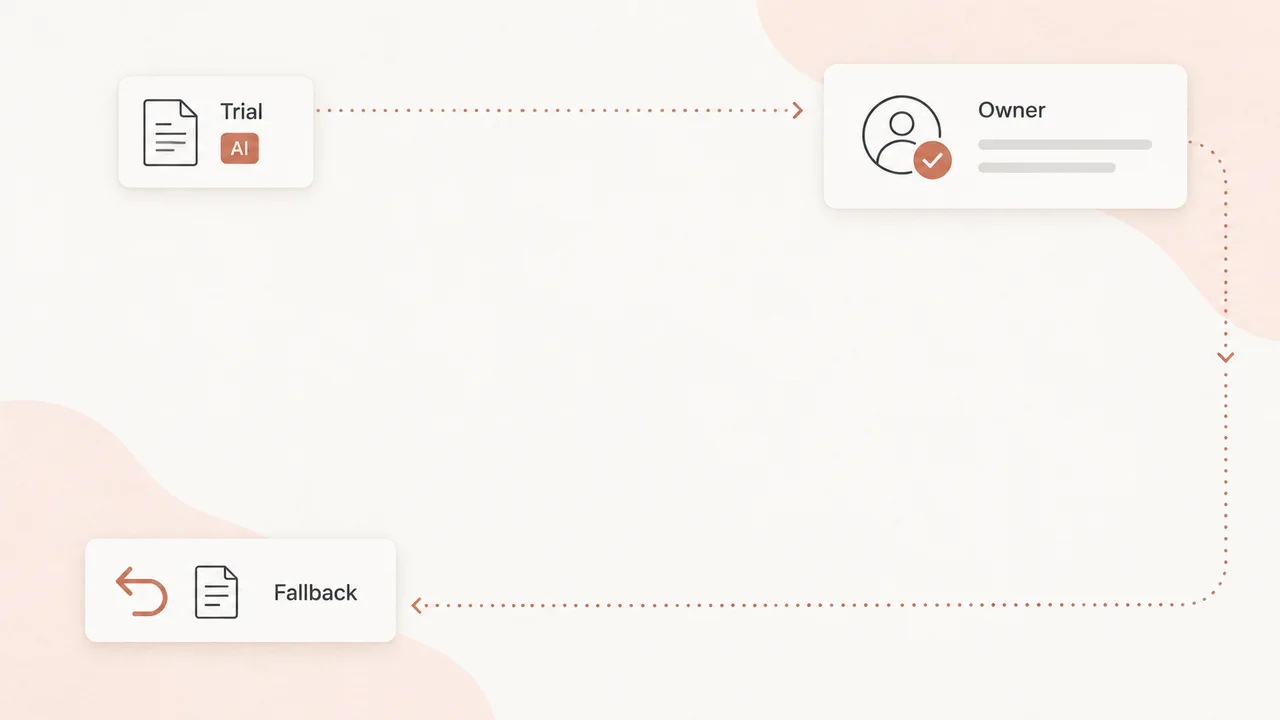
| Owner | A named commercial lead, with an operations lead checking the delivery assumptions. |
| Cost limit | An illustrative cap of two staff-days for interviews and proposal preparation. Any pilot requires a separate agreed cost limit. |
| Observable threshold | Agreement from an authorized buyer to a priced, scoped pilot that meets the provider’s stated delivery and margin requirements. This permits a pilot, not a wider launch. |
| Review date | Enter a calendar date before outreach begins. Review the findings and spending then, including unanswered questions. |
At that review, choose proceed, revise or stop. Proceed means committing to the next bounded test supported by the evidence. Revise means changing the customer group, offer or assumption because the findings point elsewhere. Stop means declining further investment when the problem is not compelling, buyers will not commit or delivery would not make commercial sense.
To assess the value of discovery, track its cost and the decisions it informs. An AI-generated forecast is not realized revenue, and an avoided investment should not be reported as a proven saving without a defensible basis. For the next commitment, use your actual research costs, proposed price and delivery assumptions. Keep unknowns visible instead of turning them into a confident return estimate.
Connect discovery to your next business move
This investigation can inform AI strategy by clarifying which growth questions deserve attention and where AI contributes useful analysis. If the work becomes recurring, transformation involves deciding how customer evidence reaches the people responsible for sales, product choices and delivery. A later build can support that process when the sources, responsibilities and value of the work are clear.
For now, choose one growth decision and collect the material that bears directly on it. Before approving further spending, check that your preferred opportunity has a traceable source trail, a competing explanation and a customer test capable of changing your mind. That gives the next conversation a concrete purpose.
Untaylored is an AI Transformation Studio working across AI strategy, transformation and build. If you want help connecting a market opportunity to a practical next step, Book a demo for an introductory conversation about the decision you are trying to make.